 Arabic
 Persian
 English


Ceasefire Violations
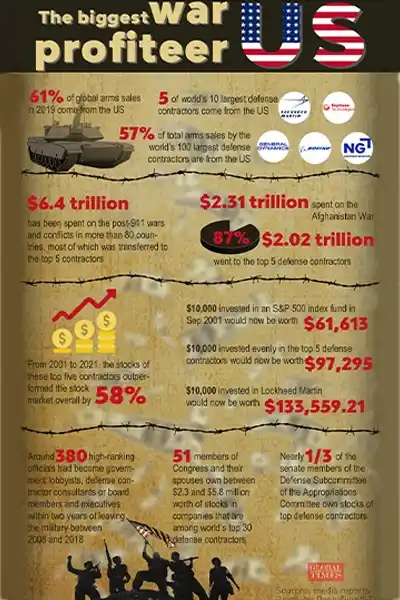
Politically, the U.S. withdrawal from war-torn Afghanistan is widely seen as a failure globally. However, analysts note that this 20-year war was an “extraordinary success” for the U.S. military-industrial complex, comprising private arms dealers, lobbyists, and Pentagon officials who profited immensely. The Institute for Security Policy Reform, a U.S. think tank, listed top beneficiaries of the Afghanistan war, including Lockheed Martin, Raytheon, General Dynamics, Boeing, and Northrop Grumman. Experts note that the U.S. military-industrial complex, fueled by economic deception, created an enemy—terrorists—across Iraq, Syria, and Afghanistan.
This recalls President Dwight Eisenhower’s 1961 warning about the rise of a “vast military establishment and large arms industry” as a hidden hand in U.S. politics. Analysts argue that the U.S. military-industrial complex relies on an axis of influence involving private dealers, lobbyists, and defense officials, creating a self-sustaining, attack-driven industry. Li Haidong, a professor at China’s Institute of International Relations, told Global Times: “The U.S. military-industrial complex has deeply shaped U.S. policy. Its main political trend and driving force is to repeatedly engage America in foreign wars for profit and to initiate new rounds of attacks.”
Grand Prize from Middle East Wars
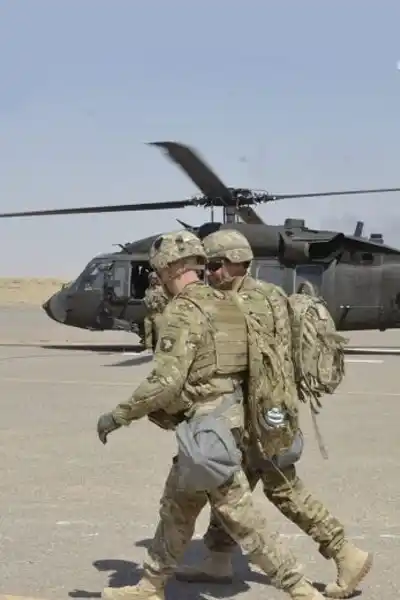
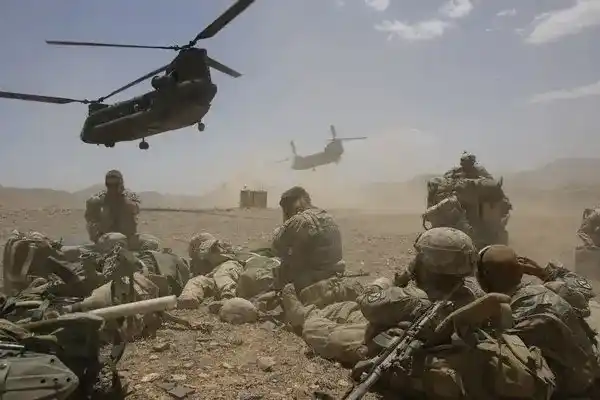
A November 2019 Watson Institute report estimated that U.S. wars in Afghanistan, Iraq, and Syria since 2001 cost taxpayers 6.4 trillion. U.S. taxpayers have been financially exploited by massive military spending. From 2001 to 2021, the U.S. defense budget has skyrocketed. The Brown University “Costs of War” project estimates the Afghanistan war cost 2.3 trillion, equating to $300 million daily for 20 years. These funds became weapons—Black Hawk helicopters, ScanEagle drones, Humvees, and carbines—used to kill in the Middle East. In under two decades, the stock prices of the five mentioned defense contractors rose 3 to 12 times. According to The Intercept, defense stocks outperformed the market by 58% during the Afghanistan war. The war enabled “legitimate killers” to build their bloody empire on Afghan skulls. Half of the world’s top 10 defense contractors are American, with 43 of the top 100 being U.S.-based.

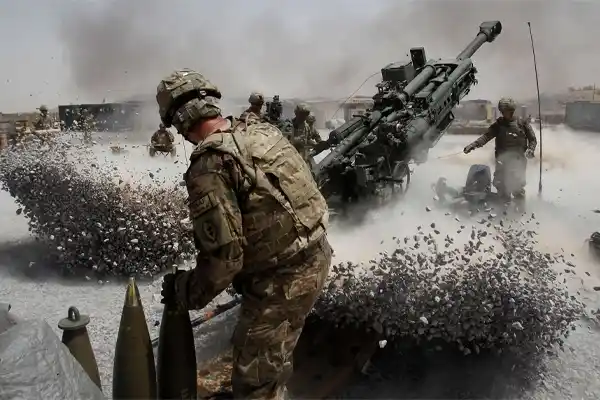
Lockheed Martin, the world’s largest defense contractor, earned 70% of its $53 billion net sales in 2018 from the U.S. government, surpassing the budgets of the IRS and EPA combined. Raytheon, the fourth-largest U.S. defense contractor, produces long-range precision missiles and is a major global arms dealer, with customers in over 80 countries. According to USA Today, the U.S. and allies rely on Raytheon’s radars and ballistic missile interceptors for defense strategies. “A significant portion of these arms deal profits was used for lobbying or political contributions, funneled into congressional pockets, explaining why defense budgets are approved so easily,” said Shin Ping, an international affairs analyst, to Global Times.
Symbiotic Relationship
Let’s go back to 2011. Julian Assange, the founder of WikiLeaks, once stated that the goal and motivation behind America’s anti-terror campaign against Afghanistan was “to have an endless war, not a successful war”… in order to launder money outside the United States… to be handed over to the hands of transnational security elites. The Swiss newspaper Neue Zürcher Zeitung expresses a similar point of view, asserting that the reconstruction of Afghanistan was never America’s real or main objective. Trillions of dollars from American taxpayers are spent on wars, and only a small portion of that spending has been used for Afghanistan’s reconstruction.”
A Foreign Policy report on August 16 stated that almost 80 to 90 percent of America’s expenses in Afghanistan ultimately return to the U.S. economy, due to the significant dependence of this country’s economy on the complex ecosystem of military-industrial complexes. According to published reports in the media, thousands of lobbyists in Washington work to promote the always-ongoing but unnecessary defense and military budget in Congress, much of which is based on personal interests.
The former Secretary of Homeland Security, Michael Chertoff, for example, purchased a very large number of expensive full-body scanners for use in airports to counter terrorist threats. However, few people know that the manufacturer of that equipment was a client of Chertoff’s security consulting agency.
This is a common trend in America: some members of Congress are interested in securing a position in those major profitable enterprises, and also in developing old schemes with their colleagues on the Hill, according to Xin Ping.
Xin stated, “And regarding the Pentagon as well, this organization acquired the weapons it needed under the slogans of supporting human rights or defending democracy. They claimed to protect those universal values, but in reality, they were protecting the endless flow of money generated by perpetual wars.2
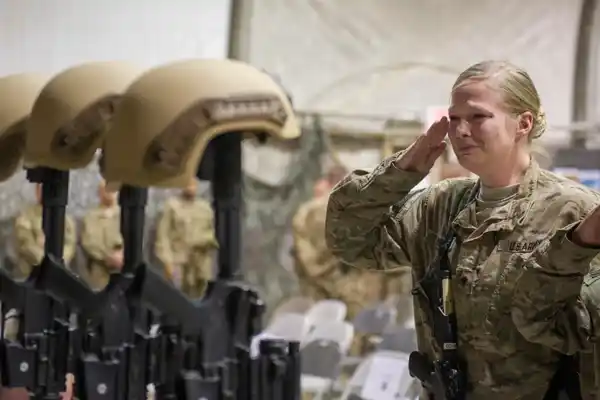
The Washington Post recently published a report that included a list of generals who commanded the war in Afghanistan and subsequently advanced in related institutions after their service ended. According to this report, these generals gained extensive influence in industries, universities, and research centers. In some cases, they even offer their experience as consultants and more; experience gained from the killing of nearly 176,000 people, at a cost of more than $2 trillion, resulting in the return of the Taliban regime.
The Washington Post reported, based on leaked information from military companies and other sources, that eight generals who commanded U.S. forces in Afghanistan between 2008 and 2018 managed to serve on the boards of more than 20 military companies.
According to an expert in the field, ordinary angry Americans never truly realize how easily and simply the military-industrial complexes get their massive budgets approved in Congress, while public opinion polls from mainstream sources show that people are strongly opposed to America’s wars in Iraq, Syria, and Afghanistan.
Jonathan Turley, a professor of public interest law at George Washington University, said in an interview with Al Jazeera: This dilemma was described by President Eisenhower as the ‘unwarranted power’ of the military-industrial complex, a power that pays no heed to public opposition or to the thousands of killed American soldiers. War may be hell for some, but for others, in a war-dependent economy, it is heaven3
Li Haidong told Global Times: The military-industrial complex, with its amassed wealth and influence, is integral to U.S. politics. Even elected officials rarely dare challenge it. The complex is embedded in industries supporting many livelihoods, forming a key economic base. Long-term, it threatens U.S. diplomacy and defense strategy, but systemic flaws prevent addressing this contradiction. U.S. foreign and defense policy lacks rational, long-term strategic vision, driven instead by clashing interest groups, far from balanced or reasonable.4





No comment