 Arabic
 Persian
 English

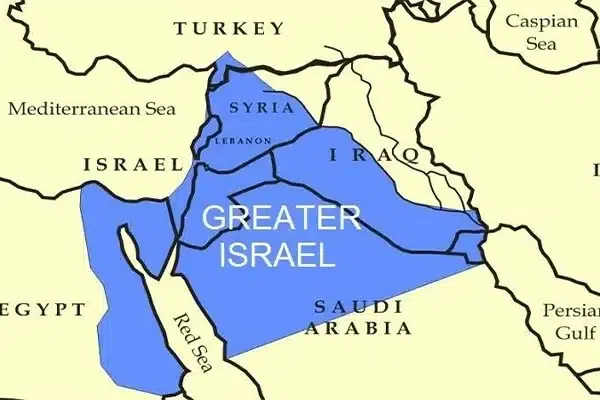
On October 7, 2023, Hamas, under the leadership of its military commander Mohammed Deif, launched the “Al-Aqsa Flood Operation.” On the same day, Netanyahu declared a so-called “state of war readiness” and officially initiated an illegal war against Palestine. In reality, the current Israeli government is committed to achieving the objectives of the “Greater Israel” plan and the “Promised Land,” which refers to the sacred Jewish homeland. Benjamin Netanyahu’s goal is to formalize and finalize the “Israeli colonial project” by seizing and occupying all Palestinian territories. His stated position, as follows, includes the complete occupation of the territories and the expulsion of all Palestinians from their homeland. He has said:
“This is a fundamental principle of this government under my leadership: The Jewish people have an exclusive and undeniable right to all areas of the Land of Israel. My government will expand and develop settlements throughout the Land of Israel in Galilee, the Negev, the Golan, Judea, and Samaria.”
The Nakba Day for Palestinian History and People
Seventy-five years ago, on May 13, 1948, a humanitarian catastrophe occurred in Palestine, known as the “Nakba.” A 2018 United Nations report declared that Palestinian territories had become uninhabitable due to a collapsing economy, a 70% youth unemployment rate, widespread contamination of drinking water, and a disintegrated healthcare system. However, under Netanyahu’s leadership, Israel continues its annexation and occupation of large parts of Palestinian land, “while driving Palestinian residents into severe deprivation and isolation.” In fact, creating conditions of extreme poverty, deprivation, and economic collapse is a Zionist tool to expel Palestinians from their homeland, forming part of the process to occupy all Palestinian territories. If successful, Israel would seize all territories acquired during the 1967 war, including the entire Golan Heights, Jerusalem (occupied Al-Quds), and most other Palestinian lands, including their best water resources and agricultural lands. Consequently, the West Bank would face the same isolation as the Gaza Strip, surrounded by Israeli military forces and settlements with no connection to the outside world.
Human Rights Violations in Palestine and Western Silence
Human rights have no meaning or application in the context of Palestine. The U.S. Congress, under the influence and control of Zionists, demonstrated its unconditional obedience as follows: “On July 19, 2023, the U.S. Congress hosted Israeli President Isaac Herzog in a special joint session. In this session, both Democrats and Republicans applauded him 29 times.” The “Greater Israel” plan envisions creating several proxy states, including parts of Lebanon, Jordan, Syria, the Sinai Desert, and sections of Iraq and Saudi Arabia, while completely erasing Palestine. The dire situation of this country is profoundly painful, and this pain is doubled by the actions of Western powers in ignoring, erasing, and strangely sanitizing it. The points raised in this text relate to the formation of the “Greater Israel” plan as the cornerstone of powerful Zionist factions in Netanyahu’s current government, the Likud Party, and Israel’s military and intelligence institutions.
The United States, Israel’s Constant Ally
In January 2017, U.S. President Donald Trump emphasized his support for Israel’s illegal settlement activities. The Trump administration also recognized Israel’s sovereignty over the Golan Heights. Now, the entire West Bank is officially being annexed to Israel. Under the Biden administration, despite rhetorical and superficial changes in political stance, Washington continues to support Israel’s programs to annex the entire Jordan Valley and illegal settlements in the West Bank.
From the Fragmentation of West Asian Countries to a Free Kurdistan
It is noteworthy that the Greater Israel plan is not merely a Zionist project for the Middle East but an integral part of U.S. foreign policy, aimed at expanding American hegemony and fragmenting all West Asian countries. In this regard, Washington’s strategy involves destabilizing and weakening regional economic powers in the Middle East, including Turkey and Iran. This policy, aligned with the Greater Israel plan, encompasses a series of divisive and conflict-inducing actions both domestically and regionally. Since the Gulf War (1991), the Pentagon has been working to establish a “Free Kurdistan” in parts of Iraq, Syria, Iran, and Turkey. According to Zionism’s founder, Theodor Herzl: “The territorial scope of the Jewish state is drawn from the Nile River in Egypt to the Euphrates.” According to Rabbi Fischmann (a key member of the Jewish Agency): “The Promised Land extends from the Nile River to the Euphrates, encompassing parts of Syria and Lebanon.”
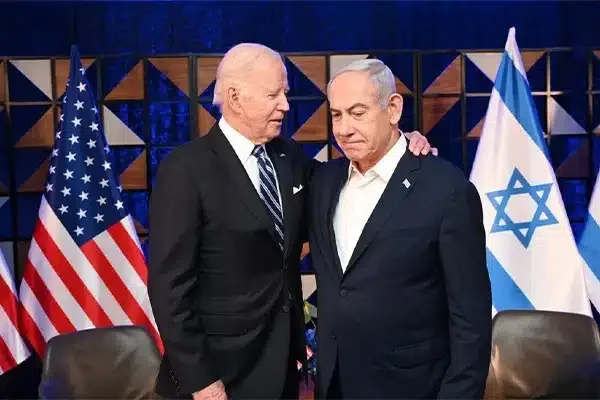
Greater Israel and the World Zionist Organization’s Plan
Taking a comprehensive look at regional events, including the Gaza blockade, it becomes clear that events such as the 2003 U.S. invasion of Iraq, the 2006 war against Lebanon, the 2011 war against Libya, ongoing wars in Syria, Iraq, and Yemen, and even political crises in Saudi Arabia are closely tied to the broader Zionist plan for the Middle East. In fact, the “Greater Israel” project aims to weaken and fragment neighboring Arab countries as part of a joint expansionist project by the U.S. and the Zionist regime, supported by NATO and Saudi Arabia. From Netanyahu’s perspective, the rapprochement between Saudi Arabia and Israel is a means to expand Israel’s influence in the Middle East and counter Iran. It is abundantly clear that the “Greater Israel” project aligns with the U.S.’s imperialist agenda in the region.
Nearly a century ago, the World Zionist Organization’s plan to establish a Jewish state included the following:
- Historical Palestinian territories
- Southern Lebanon up to Sidon and the Litani River
- Syria’s Golan Heights, Hauran Plain, and Daraa
- Control of the Hijaz Railway from Daraa to Amman in Jordan, as well as the Gulf of Aqaba
Some Zionists even claimed all the territories in the region from the Nile River in the west to the Euphrates in the east, encompassing all of Palestine, Lebanon, western Syria, and southern Turkey. This Zionist project supports the process of Jewish settlement. Broadly, this plan includes the policy of ethnically cleansing Palestinians from their homeland and annexing the West Bank and Gaza to Israel. The “Greater Israel” project also envisions creating a collection of proxy states, including parts of Lebanon, Jordan, Syria, the Sinai Desert, and sections of Iraq and Saudi Arabia.
The Yinon Plan on the Zionist Agenda
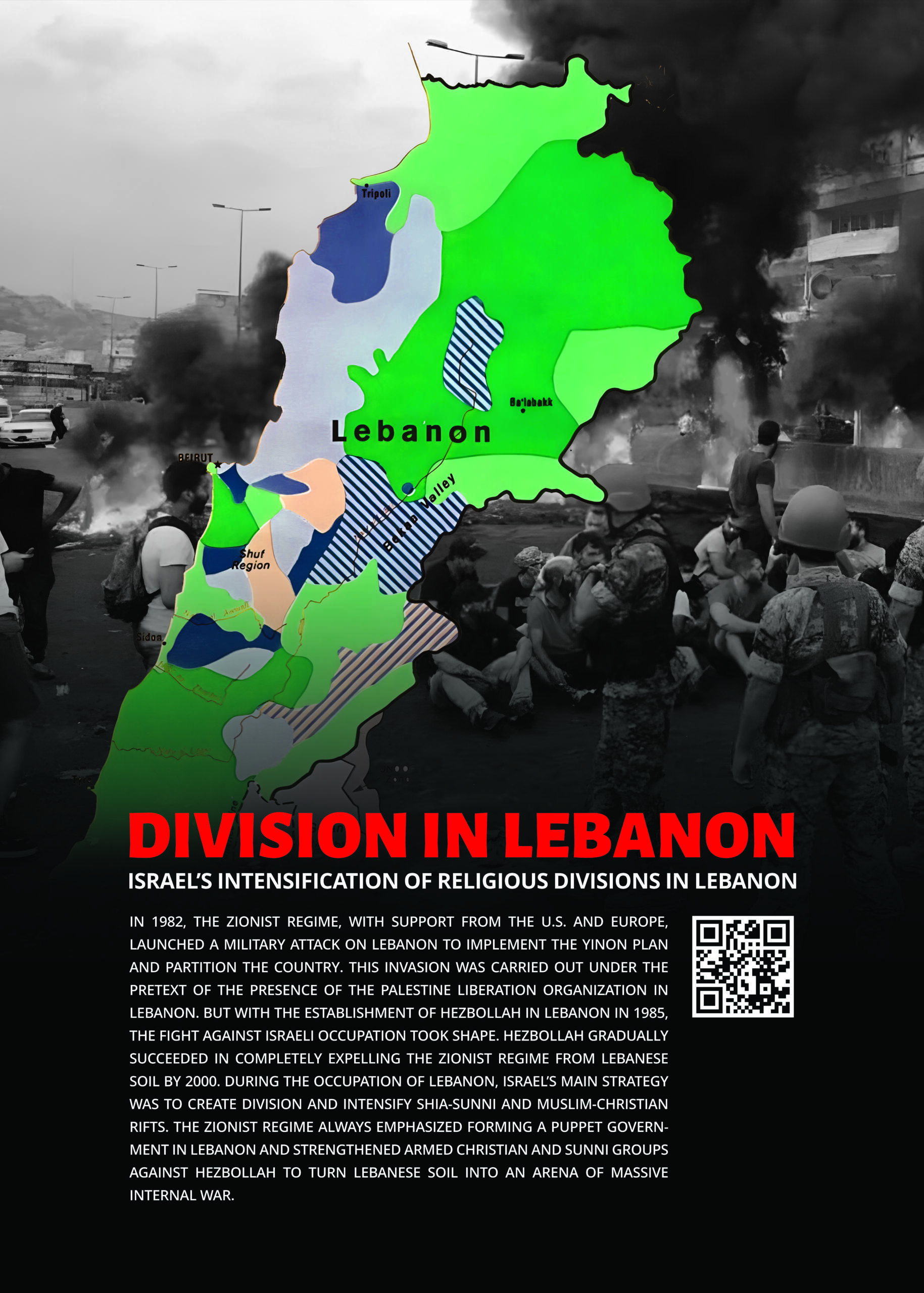
According to Mehdi Darius Nazemroaya in a 2011 article, the “Yinon Plan” (Greater Israel) continues the British colonial strategy in the Middle East and is a strategic plan by Israel to ensure its regional dominance. The stated goal is that Israel must reconfigure its geopolitical environment by balkanizing (fragmenting) surrounding Arab countries into smaller, weaker states. Israeli strategists viewed Iraq as their greatest strategic challenge among other Arab countries. Thus, in this plan, Iraq was identified as the centerpiece of the balkanization of the Middle East and the Arab world. Based on the core concepts of the Yinon Plan, Israeli strategists planned to divide Iraq into a Kurdish state and two Arab states—one for Shia Muslims and another for Sunni Muslims. The first step toward this division was the Iraq-Iran War, initiated under the Yinon Plan.
In 2008, The Atlantic magazine and the U.S. Armed Forces Journal in 2006 both published and promoted maps derived entirely from the Yinon Plan. Beyond a fragmented Iraq, which the Biden Plan also pursues, the Yinon Plan envisions the division of Lebanon, Egypt, and Syria. Additionally, the fragmentation of Iran, Turkey, Somalia, and Pakistan is part of this Zionist agenda. Furthermore, the Yinon Plan aims to balkanize North African countries, starting with Egypt and then extending to Sudan, Libya, and other states.
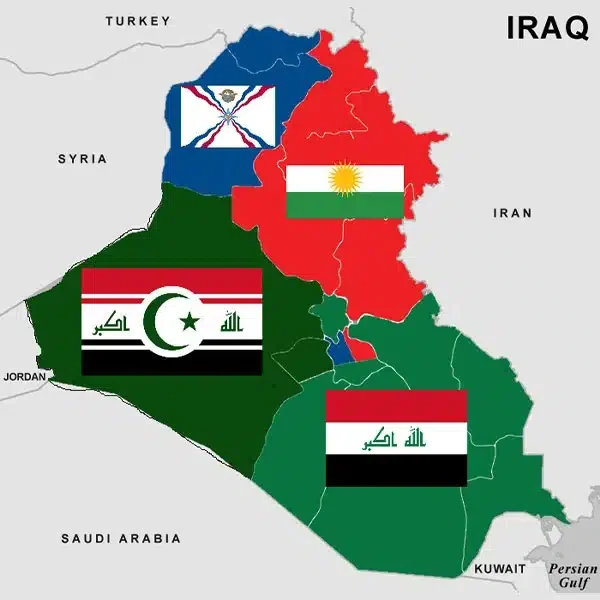
The Implementation of the Greater Israel Plan Equals the Fragmentation of Arab Countries
The Greater Israel plan has two fundamental premises. For Israel to maintain its existence, it must not only become a regional imperialist power but also fragment all Arab countries in the region into smaller states. Here, “small” refers to the ethnic or sectarian composition of each state. Consequently, Zionists hope that sectarian states will become satellites of Israel and a source of its moral legitimacy. This idea is not new and did not first emerge in Zionist strategic thinking. In fact, fragmenting all Arab countries into smaller units is a recurring theme in their vision. Considering this, the U.S. and NATO wars in Syria and Iraq are part of the process of Israel’s territorial expansion. In this context, the defeat of U.S.-backed terrorists (ISIS, Al-Nusra) by Syrian forces, supported by Russia, Iran, and Hezbollah, represents a significant setback and obstacle to achieving Zionist goals.
The Israeli Olympic Team and Support for Genocide



No comment